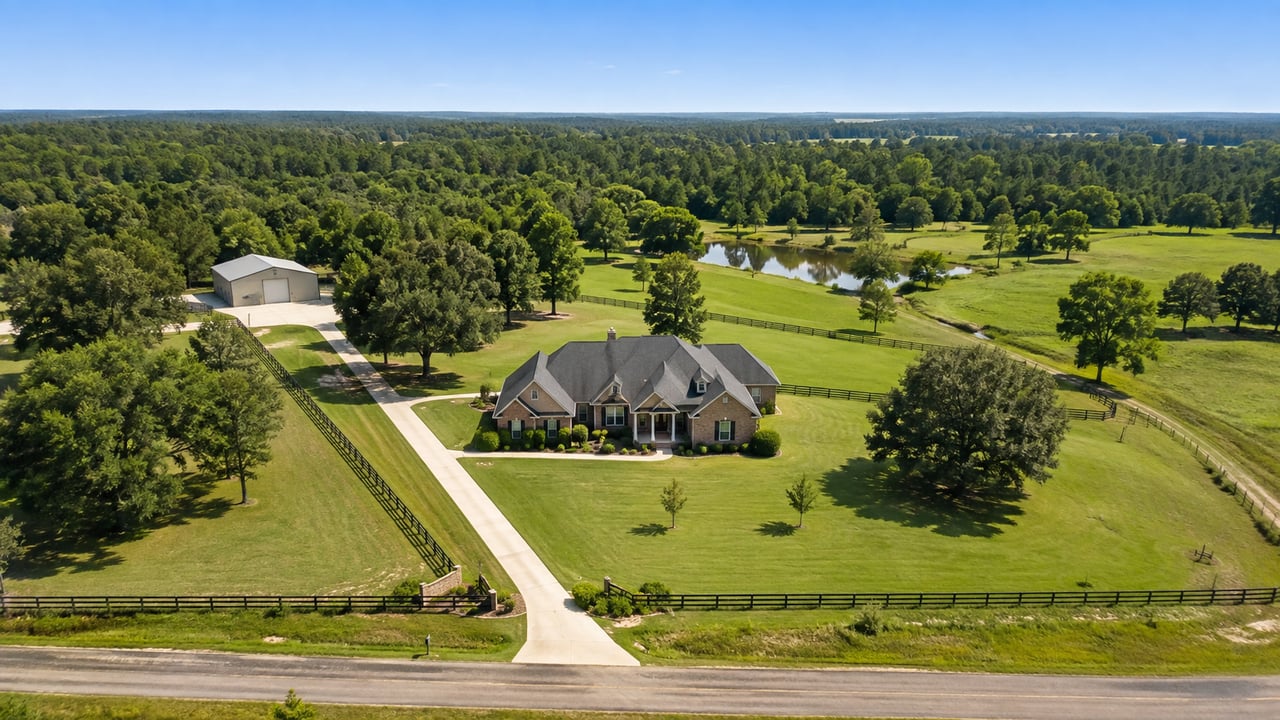
Selling a home on acreage in Northeast Texas is different from selling a traditional house in town.
When a buyer is looking at a rural property in places like New Boston, De Kalb, Simms, Maud, Redwater, Hooks, or the surrounding Bowie County area, they are evaluating much more than the house itself. They may also be considering the land, fencing, ponds, barns, shops, timber, road access, utility setup, agricultural use, and how the property fits their long-term goals.
That means sellers need a different strategy.
A home on acreage may be worth more because of the land and improvements that come with it, but it can also appeal to a narrower group of buyers. Proper pricing, preparation, photography, and marketing become especially important.
Here are some of the biggest things Northeast Texas property owners should consider before putting a home on acreage on the market.
A Home on Acreage Is Really Two Assets in One
One of the biggest differences with rural real estate is that buyers are evaluating both the residence and the land.
For a traditional neighborhood home, comparable properties may be relatively straightforward. You can often find similar houses nearby with comparable square footage, lot sizes, ages, and features.
Acreage properties are rarely that simple.
One property might have five mostly wooded acres. Another may have 12 open acres with fencing. A third could include a pond, barn, shop, creek, mature timber, or pasture.
Even two homes with similar square footage can have completely different market values because of what surrounds them.
That is why pricing rural property requires looking beyond the home's price per square foot.
Pricing Acreage Requires More Than Price Per Acre
It can also be misleading to simply multiply the number of acres by an average "price per acre."
Current land listings illustrate how much land values can vary. Land.com currently reports a median asking price of roughly $8,000 per acre for land listed in Bowie County, but that number combines many different property types, locations, tract sizes, and land characteristics.
A five-acre homesite close to town may command a very different price per acre than a 100-acre timber tract.
When determining the value of a home on acreage, we need to evaluate factors such as:
- The house itself
- Total acreage
- Road frontage and access
- Usable versus heavily wooded land
- Fencing and cross-fencing
- Ponds, creeks, or other water features
- Barns, shops, sheds, and other improvements
- Timber
- Pasture quality
- Location and proximity to town
- Recent comparable sales
The goal is to understand how all those pieces work together rather than assigning one blanket value to every acre.
Buyers Want to Understand the Land
When marketing acreage, it's important to answer questions buyers may have before they ever schedule a showing.
How much of the property is wooded?
Is it fenced?
Is there a pond?
Where are the property boundaries?
Is there a shop or barn?
Does the property have road frontage?
Is there room for livestock?
Could someone hunt on the property?
Is the land currently being used for agriculture?
These details can be just as important as the number of bedrooms and bathrooms.
For many acreage buyers, the land is actually the reason they are interested in the property in the first place.
A Current Survey Can Be Extremely Valuable
Property boundaries can become a major consideration when selling acreage.
Existing fence lines do not always match legal boundary lines exactly, and large or irregularly shaped tracts can be difficult for buyers to understand from listing photos alone.
If a recent survey is available, it can provide helpful information about:
- Property boundaries
- Acreage
- Easements
- Road frontage
- Improvements
- Encroachments
The title company and surveyor ultimately handle the legal details, but having good property information available early can make the listing easier for potential buyers to evaluate.
Easements and Access Matter
Access is especially important with rural property.
Some acreage properties front a public county or farm-to-market road. Others may use private roads or recorded easements.
Sellers should understand how their property is accessed and disclose known information appropriately.
A buyer looking at 20 acres behind another property will likely want to understand their legal right to enter and leave the tract.
Likewise, buyers may want to know about utility easements, pipelines, transmission lines, or other recorded matters affecting the property.
These aren't automatically negative features, but they are part of the complete picture.
Agricultural Valuation Should Be Discussed Early
Many rural properties in Northeast Texas have some form of agricultural use.
Sellers and buyers sometimes refer to this as an "ag exemption," although it is generally more accurate to describe it as an agricultural valuation for property-tax purposes.
If the land currently receives special valuation, buyers may want to know:
- What agricultural use is currently taking place
- Whether cattle are being grazed
- Whether hay is being produced
- Whether timber or wildlife management is involved
- Whether the new owner intends to continue qualifying use
Tax treatment can be an important consideration when buying rural land, so sellers should gather the documentation they have rather than making assumptions about what a future owner will qualify for.
Rural Improvements Can Add Real Appeal
A home on acreage often has improvements that don't fit neatly into a standard home valuation.
Examples include:
- Metal shops
- Detached garages
- Equipment barns
- Horse stalls
- Storage buildings
- RV hookups
- Covered parking
- Storm shelters
- Greenhouses
- Outdoor kitchens
- Generators
- Fencing and gates
These features can be extremely attractive to the right buyer.
However, sellers should be realistic about the difference between cost and market value.
Spending $50,000 on a shop does not automatically add $50,000 to the sale price.
The market determines how much buyers are willing to pay for those improvements.
Professional Photography Is Especially Important
Marketing acreage with only a few exterior photos is a missed opportunity.
The listing should help potential buyers understand the entire property.
That may include professional photography of:
- The home
- Interior spaces
- Exterior improvements
- Shops and barns
- Pond or creek
- Pasture
- Wooded areas
- Fencing
- Entry gate
- Road frontage
- Aerial views
Drone photography can be particularly useful because it helps buyers understand the property's layout in a way ground-level photos cannot.
Aerial imagery can show how the home sits on the land, where improvements are located, how much of the property is wooded, and how the tract relates to nearby roads.
When buyers are searching online, those images may be the difference between scrolling past a listing and scheduling a showing.
Marketing Should Sell the Lifestyle Too
Acreage buyers aren't always just purchasing square footage.
They're often buying a lifestyle.
They may imagine drinking coffee on the porch with no neighbor directly beside them.
They may want room for horses, cattle, chickens, or a garden.
They may want somewhere to hunt, fish, ride ATVs, build a shop, or simply enjoy privacy.
Good marketing communicates what makes the property unique without exaggerating.
Instead of only saying:
"3 bedroom, 2 bathroom home on 10 acres."
A strong marketing strategy should help buyers understand what those 10 acres actually offer.
Are they wooded?
Open pasture?
Fenced?
Does the property have a pond?
A shop?
Great views?
Privacy?
The details matter.
Acreage Properties May Take Longer to Sell
Sellers should also understand that a rural property may have a smaller potential buyer pool than a traditional home.
Current Bowie County residential listings are averaging about 86 days on market, according to Realtor.com. Dedicated farm listings in the county have recently shown a median marketing time around 99 days on Land.com.
Those figures aren't a prediction for any individual property, but they illustrate an important point.
Acreage properties can take time.
Someone looking for exactly five acres with a shop and pond near New Boston represents a smaller pool of buyers than someone simply looking for a three-bedroom home under a particular budget.
That does not mean the property is undesirable.
It means the marketing strategy needs to reach the right audience.
Financing Can Affect the Buyer Pool
Financing may also become more complicated when acreage is involved.
Traditional residential lenders may handle a home with a modest amount of land without difficulty.
Larger acreage tracts, agricultural operations, unusual improvements, or properties where land represents a substantial portion of the total value may require different loan products.
Texas REALTORS® notes that farm, ranch, and land transactions can involve specialized considerations including financing, leasing, land management, and current land values.
For sellers, the takeaway is not to assume every buyer will finance an acreage property the same way they would finance a home in a subdivision.
Don't Ignore the House While Focusing on the Land
One mistake acreage sellers can make is assuming the land will compensate for everything about the house.
Buyers still care about condition.
A beautiful tract of land doesn't necessarily make buyers overlook deferred maintenance, roof issues, HVAC concerns, damaged flooring, or cluttered interiors.
Before listing, sellers should consider the same basic preparation that benefits almost any home sale:
Clean thoroughly.
Declutter.
Address obvious repairs.
Improve curb appeal around the house.
Make entrances inviting.
Remove unnecessary equipment or debris from key areas.
You don't have to make the property look like a subdivision home, but buyers should feel that it has been cared for.
Make the Property Easy to Show
Showing acreage takes more time than showing a traditional home.
A buyer may want to walk the boundary, inspect a shop, look at fencing, visit a pond, or drive around part of the property.
That makes accessibility important.
If gates are locked, livestock is present, or certain parts of the property require special instructions, that information should be communicated clearly.
The easier it is for qualified buyers to fully experience the property, the better chance they have of understanding its value.
Know Who Your Buyer Might Be
One of the advantages of marketing acreage is that there may be several different potential audiences.
Your buyer could be someone looking for:
- A primary residence with privacy
- A small homestead
- Horse property
- Hunting land
- Recreational acreage
- A place for cattle
- A workshop or business space
- A weekend property
- A long-term land investment
Understanding which features of the property matter most to those buyers helps determine how the listing should be positioned.
A property with mature hardwoods, trails, and a creek should be marketed differently from an open pasture property with fencing and a cattle barn.
Key Takeaways for Northeast Texas Acreage Sellers
Selling a home on acreage requires looking at the entire property rather than simply the house.
Before listing, sellers should consider:
- The value and characteristics of the land
- Home condition and improvements
- Surveys and boundaries
- Road access and easements
- Agricultural use
- Fencing, ponds, shops, and barns
- Professional photography and drone imagery
- Financing considerations
- The specific buyer likely to be attracted to the property
- A realistic marketing timeline
The more clearly a property is presented, the easier it becomes for buyers to understand why it is special.
Final Thoughts
Homes on acreage are one of the things that make Northeast Texas real estate unique.
From a few acres outside New Boston to larger properties around De Kalb, Simms, Redwater, Maud, and the surrounding countryside, these properties offer buyers something that can't always be measured by square footage alone.
Space, privacy, timber, pasture, water, shops, barns, and recreational opportunities all contribute to the property's appeal.
That is also why selling acreage requires a thoughtful pricing and marketing strategy.
If you're considering selling a home on acreage in Northeast Texas, I'd be happy to look at the house, land, improvements, recent comparable sales, and current competition to help determine how your property should be positioned in today's market.
If you’re thinking about buying or selling property in the Texarkana area, Bowie County, or surrounding communities, I’d be glad to help guide you through the process.
Reach out anytime to start the conversation.